

Reading this on your phone?
Browser extensions can't run on phones. On iPhone and iPad, dual subtitles on YouTube work in the free Linglass app.
If you're learning Korean with K-dramas, there's a specific setup you want: the Korean subtitles on screen, matched to what the actors are saying, with an English line right underneath for the words you don't know yet. Hear the line, read it in Hangul, check the meaning — one glance, no pausing.
No streaming platform offers this. Netflix shows one subtitle track. Viki shows one track. YouTube shows one too. Search any Korean-learning forum and you'll find the same question asked for years, usually answered with "you can't," or with a link to a subtitle-file site and a page of sync instructions.
You can, and without hunting down files. This guide covers the free setup that puts Korean and English subtitles on screen at the same time, where it works, and what to do when a show has no Korean subtitles — or no English ones — to begin with.
Get dual subtitles for K-dramas — free →
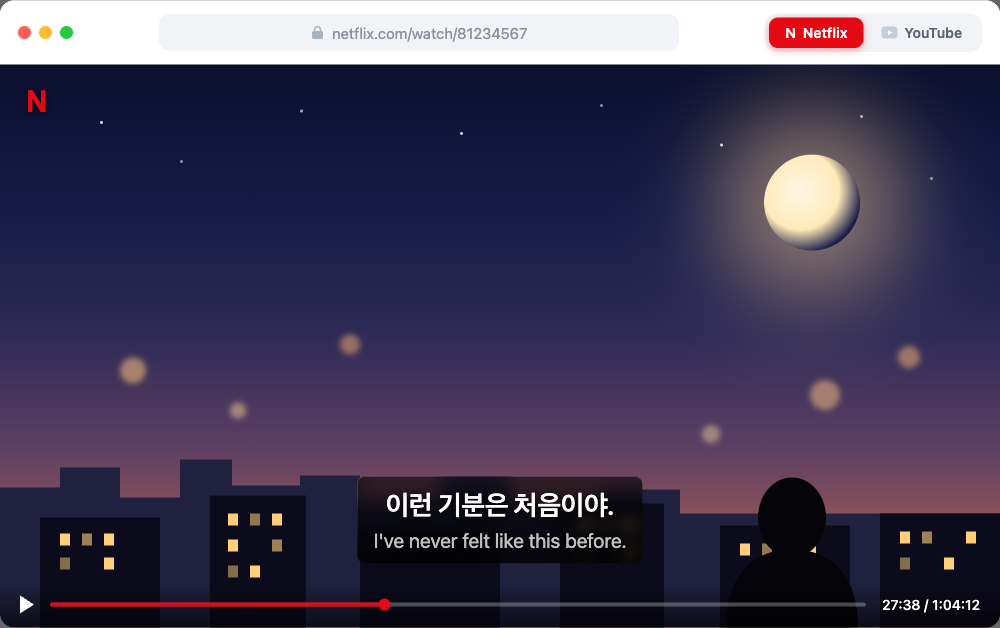
Can you watch K-dramas with two subtitle languages at once?
Not natively — no streaming player renders two subtitle tracks together. The way to do it is a browser extension: it keeps the Korean subtitles and draws a second, translated line right below them. Linglass does this for free on Netflix, YouTube and Viki in any Chromium browser (Chrome, Edge, Brave, Opera), and it was built for exactly this use case — the second line is there for learning, not just convenience, so every word on the Korean line is clickable for its romanization and meaning.
Two things it is not: it's not Netflix's or YouTube's built-in translation, which replaces the Korean line with a machine translation so you never see both; and it's not a downloaded .srt you have to find, match to your episode, and re-sync every time it drifts. It works on the streaming site you already use, on whatever you're already watching.
Why you want both lines
Watching a K-drama with English subtitles only is entertainment — your brain reads English and tunes the Korean out. You finish the series no better at Korean than when you started. Watching with Korean subtitles only works, but every unknown word means pausing, copying Hangul into a dictionary, losing the scene — and Korean's particles and verb endings make guessing from context hard early on.
Dual subtitles are the middle path that makes a drama learnable: the Korean line connects the sounds you hear to the words on screen, and the English line is a safety net you glance at only when you're stuck. If you want the fuller method — spaced pacing, which shows are watchable at which level, how to mine sentences — this article is about the setup itself; start here and the rest follows.
Netflix: the biggest legal K-drama catalog
Netflix carries most of the shows people mean when they say "K-drama," and Linglass adds the second subtitle line the same way on all of them: open an episode, and the extension pins the English translation under the Korean subtitles — matched cue by cue, so the two lines never drift apart.
The setup takes two minutes:
- Install Linglass from the Chrome Web Store.
- In its settings, set Korean as the language you're learning and English (or your native language) as the translation.
- Open any show — both lines render together in the player.
Once set, it applies to every episode. No per-title configuration.
One thing to check: whether the title carries a Korean subtitle track in your region. Netflix's own Korean productions almost always do; some licensed titles ship only a dubbed audio track plus your local subtitles. Open Audio & Subtitles on the title page — if Korean is listed, turn it on once in Netflix's own menu when you first open the show. Netflix only loads the track it considers active, and this makes the Korean line available to the extension immediately.
YouTube: variety shows, clips, and vlogs
There's far more Korean on YouTube than most learners tap: official channels like KBS World and SBS run variety shows and drama cuts with subtitles, and beyond that there are interviews, idol content, everyday vlogs and Korean creators talking at natural speed. It's the best place to hear conversational Korean outside a script.
The setup is identical — install, set Korean → English, open a video with Korean captions, and both lines render. Two extra cases YouTube throws at you:
- Rough auto-captions. YouTube's auto-generated Korean arrives as a run-on stream with awkward breaks. Linglass re-segments it into readable lines before translating, so even auto-captioned videos are watchable.
- No captions at all — common for vlogs, older uploads and smaller channels. See the next section.
What if a show has no Korean subtitles — or no English ones?
This is where most tools stop, and it's the exact complaint that fills the search results: "Netflix has no English subtitles for this Korean show," "where can I even find Korean subtitles for a drama?" Two different gaps, and Linglass handles both:
- No Korean captions (a YouTube vlog, a clip, an older upload): Linglass generates them. It transcribes the Korean audio into clean, readable subtitle lines and shows the translation underneath — so uncaptioned content becomes study material too.
- A Korean track exists, but no translation into your language (a regional Netflix title that ships Korean subtitles but no English): Linglass translates the Korean line itself and renders it as the second line, so you still get both — Korean on top, your language below.
The one case nobody can solve: a title with no Korean subtitle track and Korean that's only in the audio, on a platform that blocks transcription. There it's a licensing gap, not a technical one — and the same show is often on YouTube in clip form, where the transcription route above works regardless.
What about Viki, Viu and Kocowa?
Viki, Viu and Kocowa are where a lot of K-drama fans watch, especially outside Netflix's catalog. Here's what works where: Linglass adds dual subtitles on Netflix, YouTube and Viki; Viu and Kocowa aren't supported. Viki's own "Learn Mode" isn't an option any more — Rakuten retired it on 31 July 2023 and hasn't brought it back.
There is one caveat specific to Viki, and it decides whether a given drama is studiable at all. Viki's subtitles are written by volunteers translating away from the spoken language, so the Korean track — the one you actually want — is the one nobody needed to write. Of 20 titles trending on Viki, only half carried any track in the language spoken on screen, and those ranged from barely started to complete. Netflix ships professional Korean subtitles far more consistently. The full picture, including how to check a track's completion percentage before starting a 16-episode series, is in Viki dual subtitles.
Reading the Korean line: romanization and meaning on tap
Dual subtitles get both languages on screen; the reading aids are what turn a drama into vocabulary. On the Korean line, tap any word and Linglass shows its romanization and meaning without pausing the scene — no copying Hangul into a separate dictionary, no losing your place. Words you want to keep go into a saved list with one tap, and from there into spaced-repetition review, so the vocabulary a show teaches you actually sticks instead of scrolling past.
This is the part generic subtitle tools skip. Two lines on screen is the easy half; being able to act on the Korean word you just heard — read it, understand it, save it — is what makes the hours count.
Isn't watching with two subtitle lines a crutch?
It's a fair worry — and it's only true if you read the English and ignore the Korean. Used in the right order, dual subtitles do the opposite of a crutch: listen first, read the Korean line to connect sound to spelling, and drop to the English only when a word blocks you. The translation removes the pausing and dictionary-digging that make Korean-only subtitles exhausting in the first months — the friction that makes most learners quit before the input ever adds up.
And you can wean off it: hide the English line any time to test yourself, and turn it back on when a scene gets dense. The goal isn't to lean on both lines forever — it's to understand enough Korean, early enough, that watching stays enjoyable while your ear catches up.
Frequently asked questions
Can you watch K-dramas with Korean and English subtitles at the same time?
Yes, with a free browser extension. Streaming players only render one subtitle track, so an extension like Linglass keeps the Korean subtitles and adds a translated line below them. It works on Netflix, YouTube and Viki in Chrome, Edge and other Chromium browsers.
How do I get Korean and English subtitles together on Netflix?
Install Linglass, set Korean as your learning language and English as the translation, then open the show. If the title lists Korean under Audio & Subtitles, turn that track on once in Netflix's own menu — the extension then shows both lines, matched to each other, on every episode.
Where can I find Korean subtitles for a K-drama?
You don't have to hunt for subtitle files. If the show carries a Korean track on Netflix or YouTube, Linglass uses it directly and adds the translation. If a YouTube video has no captions at all, Linglass transcribes the Korean audio into subtitle lines itself — so you get a Korean line even when none was published.
What if Netflix has no English subtitles for a Korean show?
Linglass translates the Korean line itself and renders it as the second line, so you still get both — Korean on top, English (or your language) below. This covers regional titles that ship Korean subtitles but no English translation.
Do dual subtitles slow down Korean learning?
Only if you read the translation instead of the Korean. Used properly — listen first, read the Korean line, glance at the English only when stuck — the second line removes the pausing and dictionary lookups that make Korean-only subtitles exhausting for learners. You can hide it any time to test yourself.
Can I get dual subtitles for K-dramas on my phone?
Browser extensions only run in desktop browsers, so not in the Netflix or YouTube mobile apps. For YouTube, the Linglass iOS app brings the same setup to iPhone and iPad — dual subtitles, tap-to-translate and flashcards in one player.
Quick recap
- No streaming player shows two subtitle tracks at once — Netflix, Viki and YouTube all render one. A free browser extension adds the second line.
- Linglass works on Netflix, YouTube and Viki in Chrome, Edge, Brave and Opera: set Korean as your learning language, English (or your native language) as the translation.
- On Netflix, turn the Korean track on once in the native menu so the extension can pair it with the translation.
- When a show has no Korean captions, Linglass transcribes the audio; when it has Korean but no English, it translates the Korean line itself — so you get both lines either way.
- Tap any Korean word for romanization and meaning, and save it to spaced-repetition review — that's what turns watching into vocabulary.
Watch K-dramas with Korean + English subtitles
Free extension for Netflix, YouTube and Viki: dual subtitles, romanization on tap, one-tap flashcards — and it can generate subtitles when a show has none.
App Store